


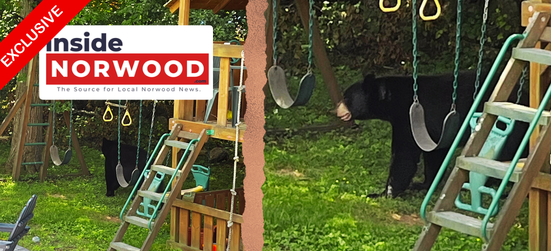
NORWOOD – It is not every day that your lunch is interrupted by New England’s largest meat-eating mammal sauntering past your flowerbeds. But for one South Norwood resident, that is exactly how the weekend began.
On Sunday afternoon, a Pilgrim Drive resident caught sight of a sizable black bear casually cutting through his suburban backyard. Keeping a safe distance, the homeowner managed to snap several clear photos of the animal as it navigated the residential property before disappearing into a nearby wooded buffer.
While black bear sightings are becoming a regular fixture of local news in communities west of Interstate 495, seeing one inside the greater Boston area, specifically in Norwood, remains a highly unusual event. According to MassWildlife, the state’s black bear population is estimated at over 4,500 and is steadily expanding eastward. However, established breeding territories are still largely concentrated in central and western Massachusetts.
When a bear makes its way down to the Norfolk County area, it is almost always a transient, young male.
“It is often these rejected, young males that wander into residential areas,” notes MassWildlife behavioral data. “Following their second winter, they are forced out of their mother’s territory and move great distances to establish their own.”
Adding to the wanderlust is the calendar: mid-June through July marks the peak of the black bear mating season, a time when these solitary roamers travel extensively and are easily drawn into suburban neighborhoods by the scent of easy meals.
Local officials and animal control departments emphasize that while seeing a black bear on Pilgrim Drive can be nerve-wracking, the animals are generally wary of humans and rarely present an aggressive threat if left alone. The primary challenge is preventing them from becoming habituated to residential areas.
To keep wandering bears wild and moving along, residents are encouraged to take a few simple precautions including bringing garbage cans out the morning of pickup rather than leaving them out overnight and pulling in the feeders because birdseed is a high-calorie jackpot for a hungry bear. Most importantly, protect your pets by keeping dogs in an enclosed or fenced area when outside and check the yard before letting them out, particularly during early morning or late evening hours.
If you happen to come face-to-face with a bear in your yard, experts advise against running or approaching the animal. Instead, back away slowly while speaking in a calm, firm voice, ensuring the animal has a clear escape route.
The Pilgrim Drive visitor didn’t linger long, seemingly just passing through town on a summer trek. Local animal control monitors these rare sightings to ensure public safety, but for now, neighbors are simply double-checking their trash lids, and keeping their cameras close. -RD


