


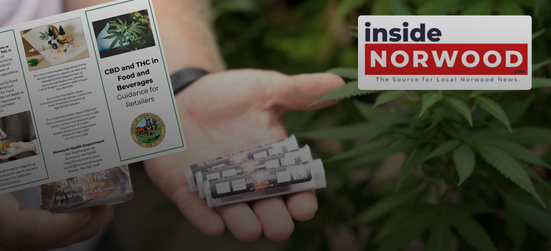
NORWOOD – Moving swiftly to protect local youth ahead of the summer season, the Norwood Board of Health voted unanimously at its June 22, 2026 meeting to enact an immediate ban on the manufacturing, sale, and distribution of synthetically derived cannabinoids and kratom.
The meeting, held at the Norwood Senior Center, finalized a regulatory process that included a public hearing last month. Board members expressed strong urgency to get the products off local shelves without delay.
“I’m all for making it effective immediately because kids are out, it’s summer,” noted board member Carolyn Riccardi. “They’re circling around. It’s very easy to take something off a shelf. I’d rather have that than have it be visible.”
As Inside Norwood reported in an article last month, synthetically derived cannabinoids are chemical compounds that are created in a laboratory to mimic the effects of naturally occurring cannabinoids found in cannabis plants, such as THC or CBD (a.k.a. marijuana). Many of these compounds are made by converting hemp-derived CBD into other intoxicating cannabinoids through chemical processes.
Unlike cannabinoids that are directly extracted from a naturally grown plant, these substances are produced through chemical synthesis or by chemically altering hemp-derived compounds. The most common products are called Delta-8 THC; Delta-10 THC; THC-O acetate; HHC (hexahydrocannabinol).
The board established a progressive fine and permit suspension system intended to deter local businesses from violating the new ordinance. While some nearby towns and state associations feature lower or higher penalties, officials described Norwood’s framework as a fair, “middle of the road” approach.
Notably, the penalties carry a heavy punch: successive violations risk the suspension or total revocation of any Board of Health permit held by an establishment. For example, if a convenience store or restaurant violates the ban, they could temporarily or permanently lose their tobacco or food permits, effectively forcing them to close.
| Violation | Fine Amount | Permit Impact |
| First Offense | $500 | None |
| Second Offense | $1,000 | 7-day suspension of all Board of Health permits |
| Third Offense | $1,500 | 30-day suspension of all Board of Health permits |
| Fourth Offense | Potential Revocation | Permanent loss of all permits (Store closure) |
By comparison, surrounding communities vary in their enforcement. Walpole imposes a lighter fine schedule of $100, $200, and $300, while Canton sits at a flat $300 across the board. On the stricter side, Needham leverages a flat $1,000 fine, and the Massachusetts Association of Health Boards (MAHB) recommends guidelines reaching up to $5,000 for later offenses.
The ban applies universally across Norwood, meaning even adult-only establishments are prohibited from selling these products. Because kratom and synthetic cannabinoids are not broadly regulated by the state, the town is utilizing local ordinances to step in.
The Health Department will handle the enforcement internally targeting common points of sale such as gas stations and convenience stores.
Town officials emphasized that the rollout will begin with a brief educational phase rather than immediate fines. Local businesses will receive an official notification letter breaking down the new guidelines and track receipt of notices. Finally, to ensure compliance the health department will conduct regular physical inspections.
“Right now, I want kratom gone,” Riccardi concluded prior to adjournment, emphasizing the board’s commitment to eliminating the public health risk. “I think Norwood is working diligently towards bringing the kids all this information and removing any danger.” -RD
Editor’s note: for more information about these substance, visit Norwood Board of Health website: https://www.norwoodma.gov/departments/health/cbd_and_thc__guidance_for_retailers.php
