


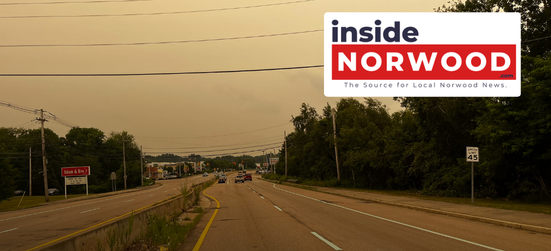
NORWOOD – If you’ve stepped outside over the last 48 hours, you’ve likely noticed the eerie, yellow-orange tint to the sky and a distinct, heavy haze hanging over Norwood.
The blanket of atmospheric smoke that arrived in Massachusetts yesterday morning has settled firmly at ground level today, prompting state officials to issue a sweeping, statewide Air Quality Alert.
Here is what is driving the poor air quality and how it impacts us locally in Norwood.
The culprit behind the hazy conditions is a massive cluster of more than 800 active wildfires burning across Canada, with a concentration of uncontained blazes in west-central Ontario, alongside several fires in northern Minnesota.
The fine particulate pollution remained relatively high in the atmosphere on Tuesday which gave us a deep pink sun and a golden hue at dusk. The shifting winds today forced that plume down into the lower atmosphere and toward ground level. The result is the current heavy, visual smog and a faint, smoky odor detectable across town.
The Massachusetts Department of Environmental Protection (MassDEP) extended its Air Quality Alert to cover the entire state through 12:00 a.m. on Thursday, July 16.
The primary concern is an elevated concentration of PM2.5 which is a microscopic, fine particulate matter that is less than 2.5 micrometers in diameter (about 30 times smaller than the width of a human hair). These tiny particles can bypass the body’s natural defense systems, traveling deep into the lungs and entering the bloodstream.
According to local air monitors, conditions in and around Norwood have fluctuated throughout the day. Currently the air monitoring data shows Norwood hitting an Air Quality Index (AQI) of 122, placing the town squarely in the “Unhealthy for Sensitive Groups” (Orange) tier.
Compounding the wildfire smoke, Massachusetts is currently weathering a summer heatwave. Meteorologists warn that the combination of high temperatures, high humidity, and heavy surface smoke poses a dual strain on the cardiovascular and respiratory systems.
According to a WGBH article published today, Glenn Keith, the director of air and climate programs at the Massachusetts Department of Environmental Protection (MassDEP), emphasized that minimizing exposure at ground level is paramount.
“The key thing is to avoid exposure. Stay indoors with windows closed so that you’re breathing indoor air and not the external air. Limit outdoor activity. If you have to be outside, choose less strenuous activities” Keith told Hannah Reale (GBH, July 15, 2026).
“Sensitive groups” include children, teenagers, older adults, anyone active outdoors, and individuals with underlying heart or lung diseases—such as asthma or COPD. Local health officials recommend high-risk individuals should limit prolonged or strenuous outdoor activities. If you usually jog along the Norwood portions of the Neponset River trails, consider moving your workout indoors today. Also, watch for sudden bouts of coughing, shortness of breath, dizziness, or chest tightness. Keep quick-relief medications and asthma action plans close at hand.
Fortunately, relief is on the horizon. Weather models indicate that weather fronts moving into the region ahead of the weekend could bring rain showers and favorable wind shifts, which should help break up and disperse the lingering atmospheric smoke by Friday or Saturday.
Until then, Norwood residents are encouraged to stay cool, keep an eye on vulnerable neighbors, and monitor real-time local updates via MassDEP’s MassAir Online tool or AirNow.gov. -RD
GBH, (2026). Boston’s hazy, yellow skies are the ‘new normal.’ Here’s what doctors advise. https://www.wgbh.org/news/health/2026-07-15/bostons-hazy-yellow-skies-are-the-new-normal-heres-what-doctors-advise
