


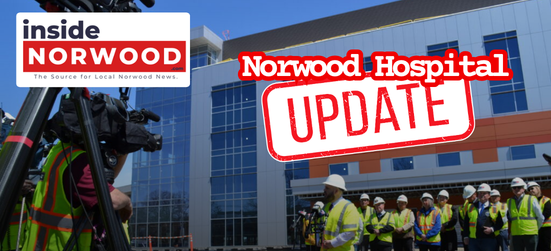
NORWOOD – Six years after a catastrophic flood turned Norwood Hospital from a thriving regional healthcare hub into an abandoned, half-built shell on Washington Street, local advocates have a reason to breathe a cautious sigh of relief. On Tuesday, June 30th, the Massachusetts House of Representatives overwhelmingly passed H.5553, a critical piece of legislation that would authorize the Commonwealth to seize the dormant hospital property through eminent domain.
The bill passed with broad, bipartisan support, signaling that lawmakers on both sides of the aisle recognize the reality facing our region: we are languishing in a healthcare desert. Ever since the implosion of Steward Health Care left the facility’s rebuilding process dead in the water, emergency response times have plummeted, and neighboring facilities like Beth Israel Deaconess in Needham and Good Samaritan in Brockton are bursting at the seams.
House passage is undeniably a major step in the right direction. It sends a clear message to the property’s current owner, Alabama-based Medical Properties Trust (MPT), that the state is losing its patience with stalled negotiations.
But let’s not pop the champagne just yet.
As any seasoned observer of Beacon Hill knows, a bill passing the House is only half the battle and history is littered with well-intentioned legislation that went to the Senate to die.
The legislative session ends on July 31. If H.5553 does not face a formal vote and clear the Senate floor before the final gavel falls, the bill is effectively dead, forcing local leaders to start back at square one next year. While State Senator Michael Rush has been a vocal champion of the measure, the Senate as a body tends to move with a deliberate, sometimes agonizing slowness.
Furthermore, even if it clears the Senate, it still requires the signature of Governor Maura Healey. While the administration has expressed deep concern over the regional healthcare crisis, executing a state-level property seizure of this magnitude carries immense financial and legal risk. Whether the Governor is truly willing to sign off on a forced taking remains an open, multi-million-dollar question.
For those unfamiliar with the term, eminent domain is the constitutional power of the government to take private property and convert it into public use, provided the property owners receive “just compensation.”
It’s the legal tool historically used to clear land for highways, public schools, or reservoirs. In this case, the “public use” is clear: restoring an acute-care hospital, complete with an emergency department and crucial cardiac care labs, to serve a 12-town catchment area of 250,000 residents.
Under the proposed law, the state’s Division of Capital Asset Management and Maintenance (DCAMM) would take ownership of the land and structures, stripping control away from MPT. The state would then facilitate a transfer or sale to a qualified, reliable nonprofit healthcare operator (like Mass General Brigham or another regional system) to finish the interior construction and open the doors.
While it is easy to cheer for eminent domain when a faceless, out-of-state real estate investment trust is holding our local healthcare hostage, we must also look at the broader, sobering precedent this action would set.
If the Commonwealth (or the Town of Norwood, which has threatened to pursue its own eminent domain taking if the state fails to act) goes around seizing private property from developers, it opens a legal Pandora’s box.
Property rights are a cornerstone of economic stability in Massachusetts. When the government decides it can step in and take over an unfinished commercial project simply because a private developer’s business deal or bankruptcy slowed things down, it sends a chilling wave through the business community.
What private developer or healthcare company will want to invest millions building facilities in Massachusetts if they fear the state might take it away if things don’t move on the politician’s timeline?
“Just compensation” doesn’t mean free. If the state takes the property, taxpayers are on the hook to pay MPT fair market value for a massive, partially reconstructed medical complex. That price tag will be determined by courts and appraisers, potentially costing the public tens of millions of dollars before a single doctor is even hired.
Ultimately, the closure of Norwood Hospital has created a legitimate public health emergency. When a heart attack patient’s ambulance ride jumps from 15 minutes to nearly 40 minutes because they have to be diverted to Boston or Brockton, lives are strictly on the line.
H.5553 is an aggressive play by our local reps to break a multi-year corporate stalemate. But as the bill moves to the Senate, residents should maintain a healthy dose of skepticism. Balancing the desperate need for local emergency care against the slippery slope of government property seizures is a tightrope walk, and the final act on Beacon Hill is bound to be a messy one. -RD
