


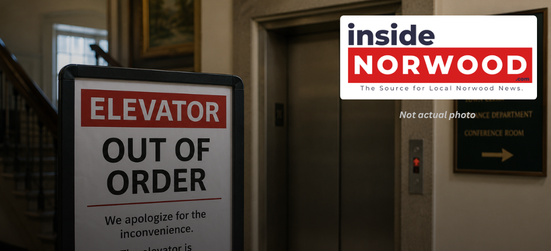
NORWOOD – For months, visitors to the Norwood Town Hall website have been greeted by the same, static red alert banner stretching across the top of the homepage: “THE ELEVATOR AT TOWN HALL IS OUT OF SERVICE: We apologize for the inconvenience.”
But as weeks turn into months, “inconvenience” has rapidly soured into a blatant failure of municipal accessibility and local accountability.
What began as a routine maintenance headline has transformed into a prolonged structural barrier for the residents of Norwood. For a historic building that serves as the literal heart of our local governance, the prolonged loss of its single elevator isn’t just a technical issue, but may be a civil rights issue. The inability of elderly residents or those with limited mobility, to access the second floor is becoming a significant hindrance for them to fully participate in their local government.
Under the Americans with Disabilities Act (ADA) and Massachusetts state regulations, public buildings are fundamentally obligated to ensure equal access to government services. While municipal leaders have made accommodations by meeting residents on the first floor or arranging virtual access, anyone who has worked within municipal systems knows that makeshift workarounds are a poor substitute for independent dignity.
Some residents have taken to social media to ask a simple, pointed question: If a private commercial building or a luxury apartment complex let an elevator sit broken for this long, wouldn’t the town’s own building inspectors be issuing fines?
Yet, when it comes to the seat of town power, the gears of bureaucracy turn at a glacial pace. We hear whispers of supply chain delays, back-ordered parts, and the unique architectural headaches of retrofitting a historic municipal structure. While those structural challenges are real, the lack of aggressive, transparent communication from administration leaves a void that is quickly filled by civic resentment.
This ongoing outage strikes a particularly sensitive nerve for Norwood taxpayers, who have watched municipal budgets expand, overrides passed and targeted capital outlay debates take over Finance Commission meetings. The town has rightfully poured resources into community highlights like the recent historic fire bell restoration and high-profile summer events, but the basic, unglamorous infrastructure of town operations seems to be catching the short end of the stick.
When senior citizens cannot comfortably climb the stairs to pull a vital record or a resident with a physical disability is barred from looking a town official in the eye during a second-floor meeting, local democracy suffers.
A town hall should be the most accessible building in a community. Right now, Norwood’s is a symbol of deferred maintenance.
Apologies on a website banner do not move wheelchairs up stairs. Moving forward, the Board of Selectmen and the General Manager owe the people of Norwood more than a passive warning label. Residents deserve a firm, publicly binding timeline for completion; a clear accounting of why procurement has stalled for this length of time; and an aggressive, proactive strategy to ensure that future capital project failures do not quietly isolate vulnerable segments of our community.
Until the elevator is running, the transparency and accessibility of Norwood’s town government remain grounded on the first floor.
Neither Town Manager Tony Mazzucco nor his Executive Assistant Lisa O’Leary responded to our numerous requests for comment about the status of the elevator. -RD
