


NORWOOD – It seems everywhere you look in Norwood someone is building something. Although progress is good, the skyline is changing so rapidly it’s difficult for the average Norwood resident to keep up.
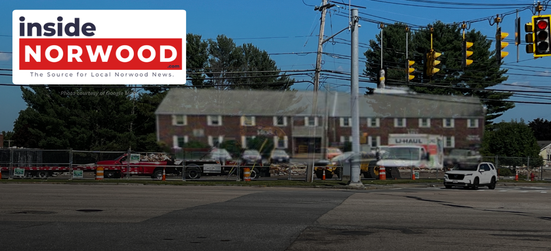
The intersection of Providence Highway and Sumner Street is no exception. Many took to social media to inquire why a perfectly good office building was demolished. Thus, Inside Norwood did some research and found some answers about how we arrived here.
On June 1, 2026 the Norwood Planning Board voted unanimously to grant site plan approval for a new early childhood education center at 1408–1414 Boston Providence Turnpike (Route 1).
The approved project will bring The Gardner School, a facility designed for 165 children aged 0 to 5 and up to 30 staff members, to the Boston Providence Highway District (BPH). Plans called for the demolition of the site’s existing structure to make way for a modern facility featuring off-street parking, an outdoor playground, new landscaping, and upgraded stormwater infrastructure.
Attorney Brian Almeida and Matt Smith of Norwood Engineering, representing property owner and applicant David Spiegel, presented the final plans to the board. According to Spiegel, who attended the meeting remotely, the proposed school will match the aesthetic and architectural design of the existing Gardner School location in nearby Dedham.
A primary focus of the meeting centered on traffic flow and safety along the heavily traveled Route 1 corridor. Responding to initial feedback from the Norwood Fire Department regarding parent parking and emergency access, Smith detailed modifications to the site layout, including shifting the main entrance farther down Sumner Street.
Planning Board member Mr. Paciorkowski raised concerns about potential vehicle queuing and safety risks at the intersection of Route 1 and Sumner Street. Smith noted that because early childhood facilities operate without fixed drop-off and pick-up bells, arrival times are naturally staggered throughout the morning, minimizing concentrated traffic surges.
To further mitigate congestion, board member Mr. Sheehan suggested traffic control measures such as a painted “Don’t Block the Box” grid on the roadway which is a strategy previously implemented elsewhere in town. Town Planning Director Sara. Dixon recommended conditioning the project’s final approval on review by the Traffic Safety Advisory Committee, including the installation of the pavement marking at the applicant’s expense.
During the site review meeting, Planning Board Chair Brian Hachey opened the floor briefly to public comment to listen to concerns from Norwood residents. One Harrow Road resident asked whether protective bollards would be placed between the parking area and the outdoor playground. Smith confirmed that a heavy-duty guardrail will be installed along the perimeter to protect the play area. A Liberty Lane neighbor voiced concerns regarding existing traffic density at the nearby intersection. Finally, a Cross Street resident questioned the selection of arborvitae in the proposed planting scheme. Smith clarified that while arborvitae had been initially suggested during design consultations, it will not be used in the final landscape plan.
In response to board member Mr. Teehan’s inquiry regarding neighborhood impacts during development, Smith confirmed that the applicant had met with local abutters to discuss construction hours, noise management, and vehicle idling restrictions.
The board also addressed a maintenance memo submitted by Mr. Ryan regarding existing site utilities. Per Dixon’s recommendation, the maintenance conditions were integrated directly into the final approval terms.
Board member Mr. Sheehan made the motion to approve the site plan subject to the special conditions, which was seconded by Ms. Holmwood. The board voted 5-0 in favor via roll call.
Because the facility operates as an educational institution, the use of the property qualifies for protections under the state’s Dover Amendment which is a state zoning law that exempts qualifying religious, educational, and agricultural land uses from broad local zoning restrictions, ensuring municipalities cannot use local bylaws to exclude these institutional priorities. -RD
